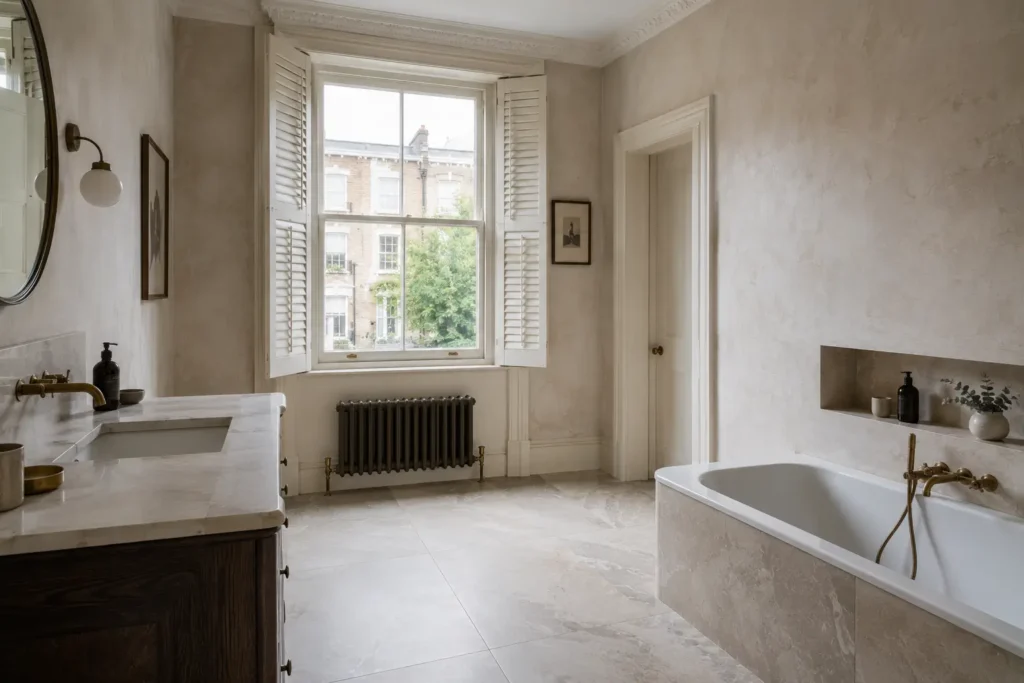
Few decisions change how a bathroom feels as much as whether the sanitaryware touches the floor. Wall-hung WCs and basins have become the default in design-led projects — but the choice is structural as well as visual, and floor-standing pieces still have rooms they win.

The Case for Wall-Hung
Lifting the WC and basin off the floor does one decisive thing: the floor runs uninterrupted beneath them. In a compact bathroom, that continuity reads as space; with a large-format porcelain floor, the effect compounds. Cleaning becomes trivial. Concealed cisterns sit within the wall, and mounting heights can be set to the household rather than to a factory standard.
What the Wall Must Do
Wall-hung pieces load the wall, not the floor. A steel installation frame — fixed to structure and clad within a false wall of roughly 150 to 200mm — carries the weight; quality frames are rated far beyond any realistic use. The false wall consumes some floor depth but returns it as a shelf line, a niche opportunity, and a home for the cistern. Access for servicing comes through the flush plate, which is worth knowing before anyone worries about it.
Where Floor-Standing Still Wins
In the period properties of Kensington and Holland Park, where walls cannot always take a frame, or where the design language is deliberately traditional, floor-standing and back-to-wall pieces remain correct. A back-to-wall WC offers much of the visual cleanliness of wall-hung — no visible cistern, no gap behind — while loading the floor. Freestanding basins on furniture bring warmth that a floating slab of ceramic sometimes lacks.
Deciding
The honest sequence: structure first, floor second, style third. If the wall can take a frame and the floor is worth seeing, hang the sanitaryware. If not, choose back-to-wall pieces and spend the saving on brassware.
Our sanitaryware is displayed installed, at height, in room settings — the difference is easier to feel than to read.