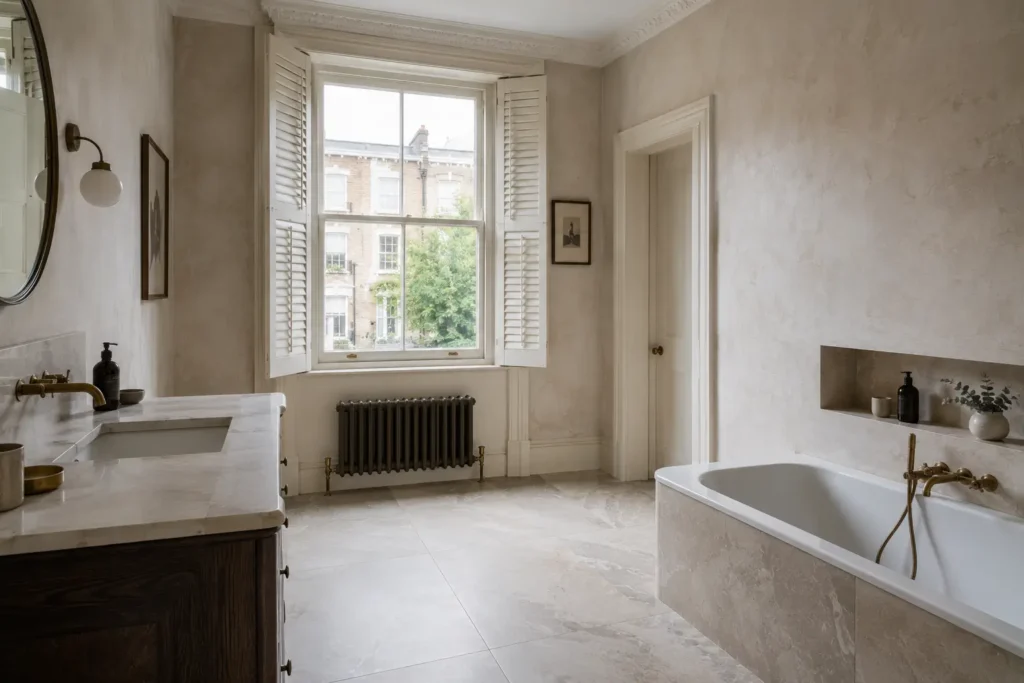
The lower-ground floors of London houses now contain rooms that did not exist in domestic specification twenty years ago. Gyms, cinemas, wine rooms and wellness suites each impose demands that no general-purpose floor satisfies, and treating them as ordinary rooms with an ordinary tile is how they disappoint.
Home Gyms: Impact, Not Wear
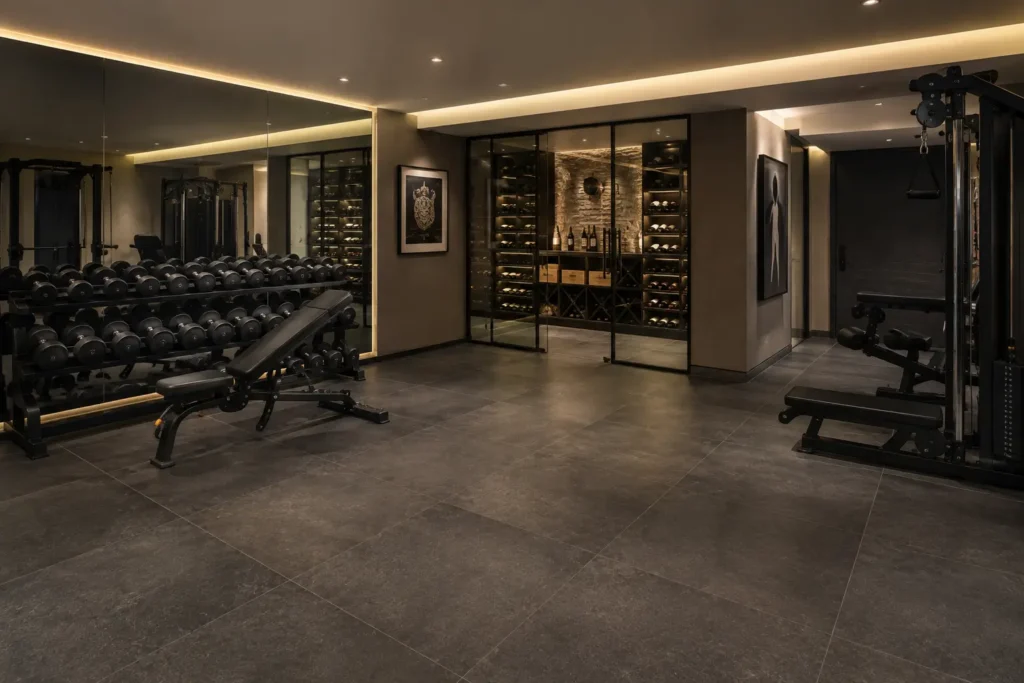
The threat in a gym is point impact, not abrasion. A dropped dumbbell concentrates its entire mass on a few square millimetres, and no tile in any material survives that indefinitely. The correct answer is layered: a porcelain floor that runs continuously through the lower ground floor, with rubber matting laid over it in the free-weight zone. The tile handles cardio areas, circulation and cleaning; the matting takes the impact and can be replaced. Full-body porcelain is preferable here, since any chip shows far less.
Specify at least R10 for a gym floor — perspiration on a matt surface is more slippery than most people expect — and choose a mid-tone that conceals dust between cleans.
Underfloor heating deserves a room-by-room decision here rather than a blanket one. A gym rarely needs it; a cinema room and a wine room emphatically do not want it. Zoning the lower ground floor so heat can be shut off room by room saves running cost and prevents a wine store being warmed by the corridor beside it.
Cinema Rooms: Acoustics Before Aesthetics
A cinema room is an acoustic project. Hard reflective surfaces produce flutter echo and undermine any speaker system, which is why fully tiled cinema rooms rarely sound as good as they look. The workable specification is a tiled floor — for continuity with adjoining spaces and for underfloor heating — substantially covered by a heavy rug or carpet, with acoustic treatment on walls and ceiling. Deep-toned porcelain suits the room, since a dark floor reduces screen reflection; a polished or lappato face should be avoided for the same reason.
Wine Rooms: Humidity and Stability
A wine room is held at around 12 to 14°C with relative humidity near 70%. Timber moves in those conditions and eventually distorts; porcelain is unaffected, which makes it the obvious floor and, increasingly, the wall surface behind display racking. In a Belgravia or Knightsbridge wine room, a dark stone-effect or slate-effect surface with concealed lighting on the bottles gives the necessary sense of depth without needing more expensive materials. Ensure the floor tolerates spilled wine — porcelain does, entirely — and specify a slip rating of at least R10, since a wine room floor is frequently damp.
Continuity Through the Floor
The strongest planning decision is to run one material through the circulation of the whole lower ground floor and vary only within the rooms. It makes a series of specialist spaces read as a coherent part of the house rather than a corridor of separate installations.
Bring your lower-ground plan and we will work through the material strategy room by room.