Porcelain and underfloor heating are the most natural pairing in modern residential specification — the material conducts heat better than any alternative and is entirely unaffected by thermal cycling. Nearly every problem that arises comes not from the pairing but from the programme: screed tiled too soon, heating commissioned too fast, or movement joints omitted.
Wet Systems and Electric Mats
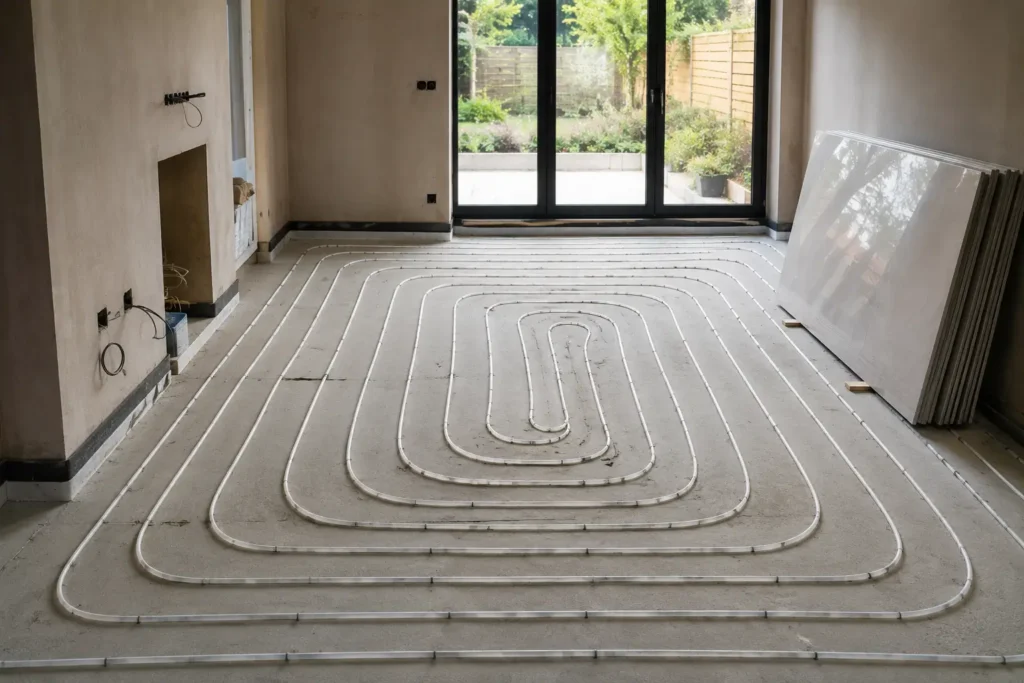
Wet systems circulate warm water through pipework set in screed. They are efficient, comfortable and the right answer for whole-floor coverage in a new build, an extension or a basement — but they require depth and a manifold, so they belong to projects with the structure open. Electric mats sit directly beneath the tile in the adhesive bed, add only a few millimetres, and are ideal for retrofitting a single bathroom in a Kensington flat where floor levels are fixed. Running costs are higher, which matters far less over a five-square-metre bathroom than over a whole ground floor.
Screed Drying Is Not Negotiable
A traditional sand and cement screed requires roughly one day per millimetre of thickness for the first 50mm, and longer beyond that — a 75mm screed can need three months. Liquid anhydrite screeds dry faster but require the laitance to be sanded off and demand a compatible primer and adhesive. Tiling onto a screed that has not reached the required residual moisture content is the single most common cause of failure on new floors.
Insist on a calcium carbide moisture test before tiling begins, and treat the result as a fact rather than an opinion. On a Chelsea basement or a rear extension running to a fixed handover, this is the item most worth protecting in the programme.
Commissioning Before and After
The heating must be commissioned before tiling: brought up gradually over several days to full working temperature, held, then brought back down and switched off for at least 48 hours before the tiler starts. This drives residual moisture out and allows the screed to complete its movement. After tiling and grouting, wait a further week, then bring the system up again in increments of about 5°C per day. Turning a new floor straight to full temperature is how a perfectly good installation cracks in its first week.
Adhesives and Movement
Specify a flexible, deformable adhesive rated for underfloor heating — S1 or S2 classification — and a flexible grout. Movement joints are required at the perimeter, at all thresholds, over any existing structural joints and at intervals across large heated areas, typically every 40 square metres or 8 to 10 metres in any direction. Heated floors expand more than unheated ones, and these joints are what absorb it.
Floor temperature should also be limited. Most manufacturers cap the surface temperature at around 27°C, and a system running hotter shortens the life of both adhesive and grout while making the room uncomfortable. A floor sensor rather than an air thermostat alone is what keeps the limit reliable.
Tell us the heating specification when you select material and we will confirm adhesive and grout alongside the tile.