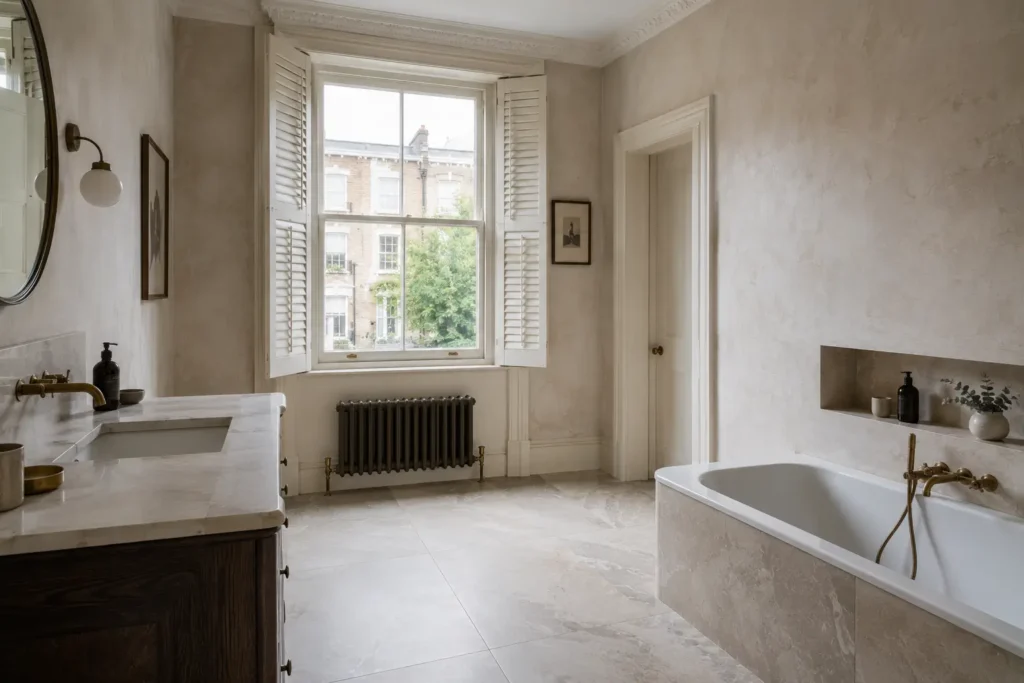
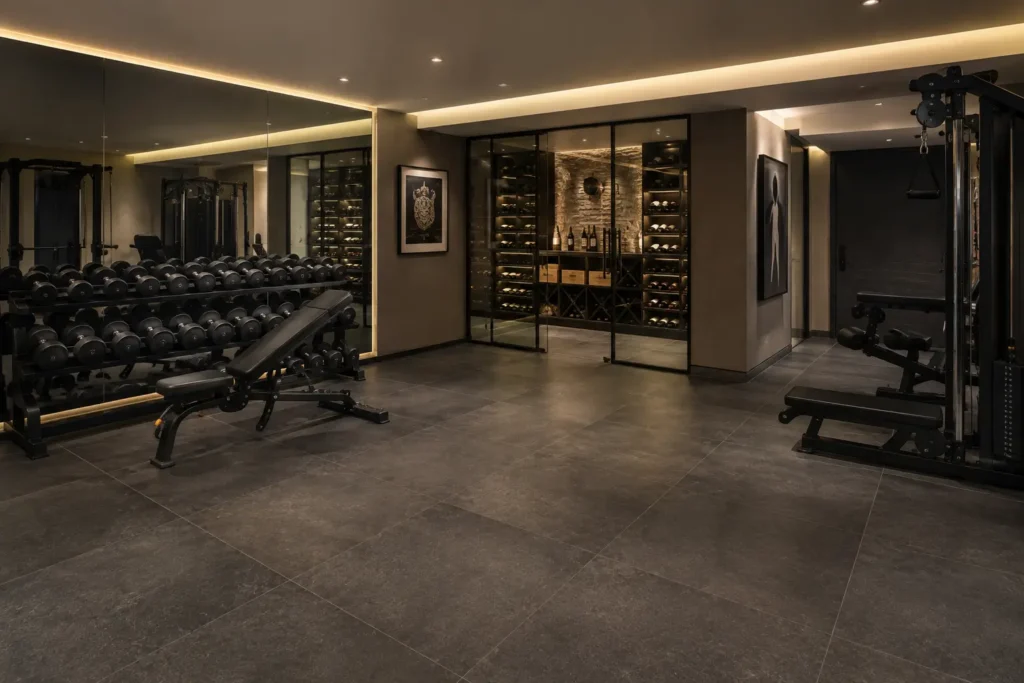
Slip resistance is the least glamorous line on a tile’s data sheet and the one most worth reading. The ratings are simple once decoded — and knowing them lets you specify a floor that is safe without defaulting to a rougher surface than the room actually needs.

The R Scale
The R rating (R9 to R13) comes from a ramp test with a shod operator on an oiled surface. R9 suits dry interiors — bedrooms, living rooms, dry hallways. R10 is the sensible baseline for kitchens and general bathroom floors. R11 belongs in showers, utility spaces and anywhere regularly wet. R12 and R13 are for external terraces, steps and pool surrounds. There is no R1 to R8; the scale simply begins at 9.
Barefoot Areas Are Measured Differently
For barefoot wet zones, the A/B/C classification applies — a barefoot ramp test with water. Class B is appropriate for shower floors and wet rooms; Class C for surfaces sloping into water — the standard question in the basement pools of Knightsbridge and Belgravia. In the UK you will also meet PTV (Pendulum Test Value): a PTV of 36 or above is considered low slip risk, and it is the figure building control and commercial specifications lean on.
The Trade-Off That Isn’t
Higher grip once meant coarser texture and harder cleaning. Current-generation surfaces have narrowed that trade considerably — several of our Italian and Spanish collections achieve R11 with a face that feels closer to natural stone than to sandpaper, and some adjust their grip when wet. This is a genuine technical advance, and a reason to look at recent collections rather than assumptions.
The Practical Rule
Match the rating to the wettest realistic condition of the room, not the driest. A bathroom floor is specified for the moment after the bath overflows, not the hour before.
Every collection at Lussano carries full technical data — ask us for the ratings alongside the samples, and we will match both to your rooms.