Three engineered materials dominate premium surface specification, and they are routinely discussed as though interchangeable. They are not. Each is made differently, fails differently, and belongs in different parts of a house — and the differences are easy to state plainly once the marketing is set aside.
What Each One Actually Is
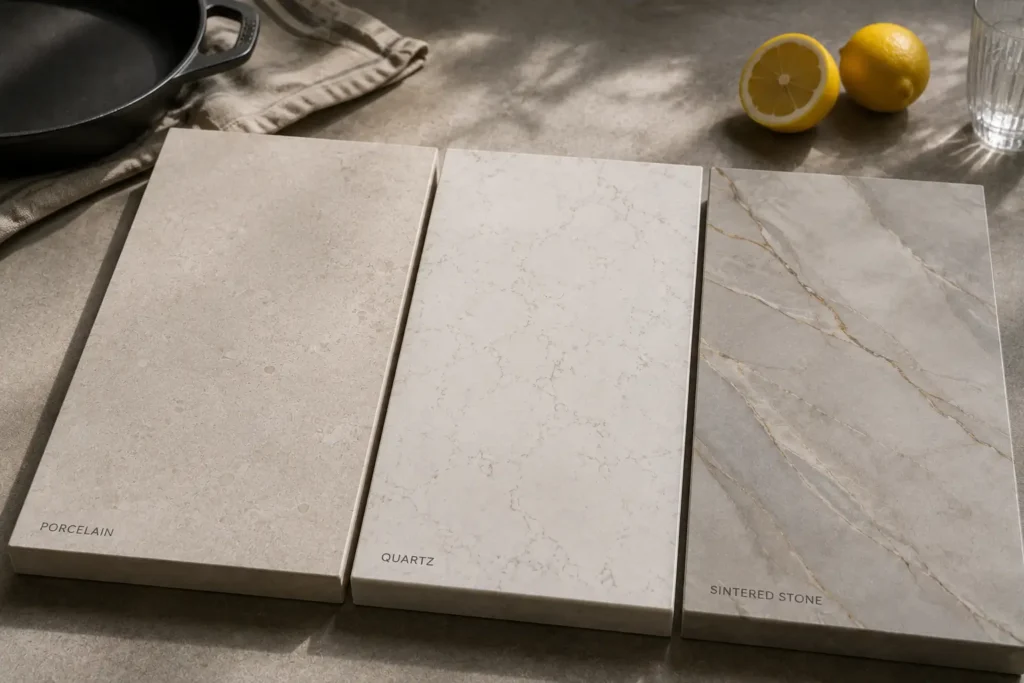
Quartz is roughly 90 per cent crushed quartz aggregate bound in a polymer resin, cured rather than fired. Porcelain is clay and mineral fired above 1,200°C, with the decorative face printed and glazed before firing. Sintered stone is natural mineral powder compacted under extreme pressure and fired without resin — closer in composition to porcelain than to quartz, and frequently produced in the same slab formats.
The resin content in quartz explains almost everything that follows. It is what gives the material its consistency and its comfortable working properties, and it is also what limits it.
Heat, UV and Staining
Porcelain and sintered stone are unaffected by a hot pan set directly on the surface. Quartz is not: the resin scorches and discolours at temperatures a roasting tin easily reaches, and every quartz manufacturer’s warranty excludes it. Under ultraviolet light the same divide appears — quartz yellows over time and is not warranted for external use or for a conservatory in Chelsea with south-facing glazing, while porcelain and sintered stone are entirely UV stable and available in 20mm outdoor formats.
For staining, all three are effectively non-porous and none requires sealing. Quartz is marginally more vulnerable to strong solvents and to permanent marking from certain dyes; porcelain is chemically inert.
Edges, Fabrication and Cost
This is where quartz answers back. Because it is a homogeneous slab through its thickness, it can be shaped, profiled and polished on the edge like stone, producing curves, drainer grooves and rounded profiles that porcelain cannot. Porcelain’s printed face means the edge must be mitred to conceal the body — beautiful when done well, and dependent on the fabricator. Quartz is also more forgiving on site, less prone to chipping during handling, and generally less expensive to fabricate.
Sintered stone sits between them: full-body composition allows a more forgiving cut edge than glazed porcelain, at a price closer to the upper end of porcelain.
Choosing by Application
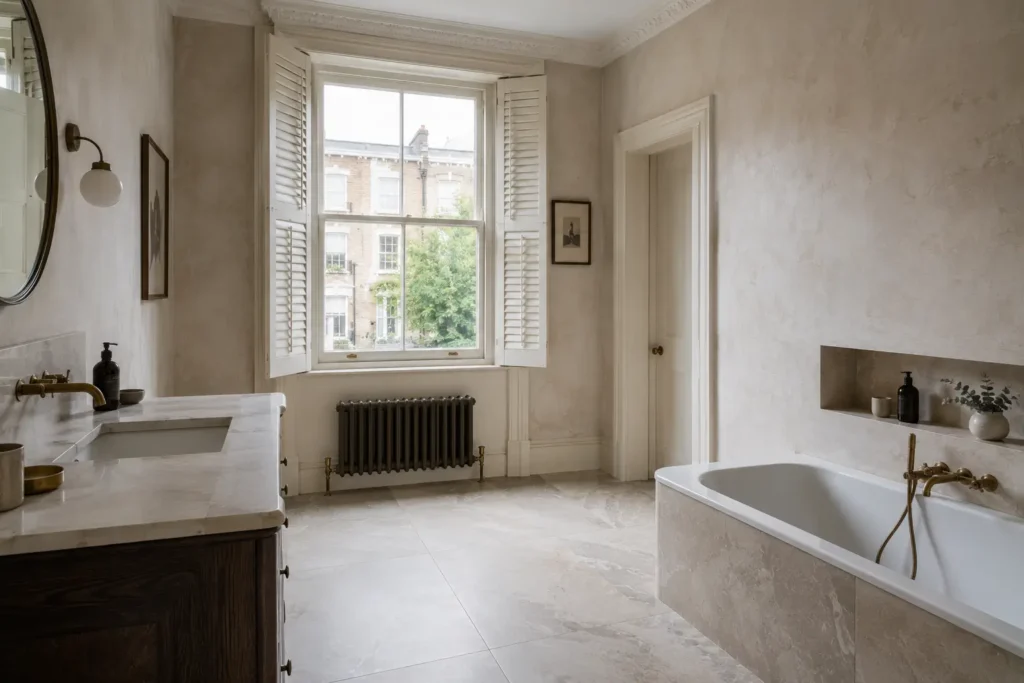
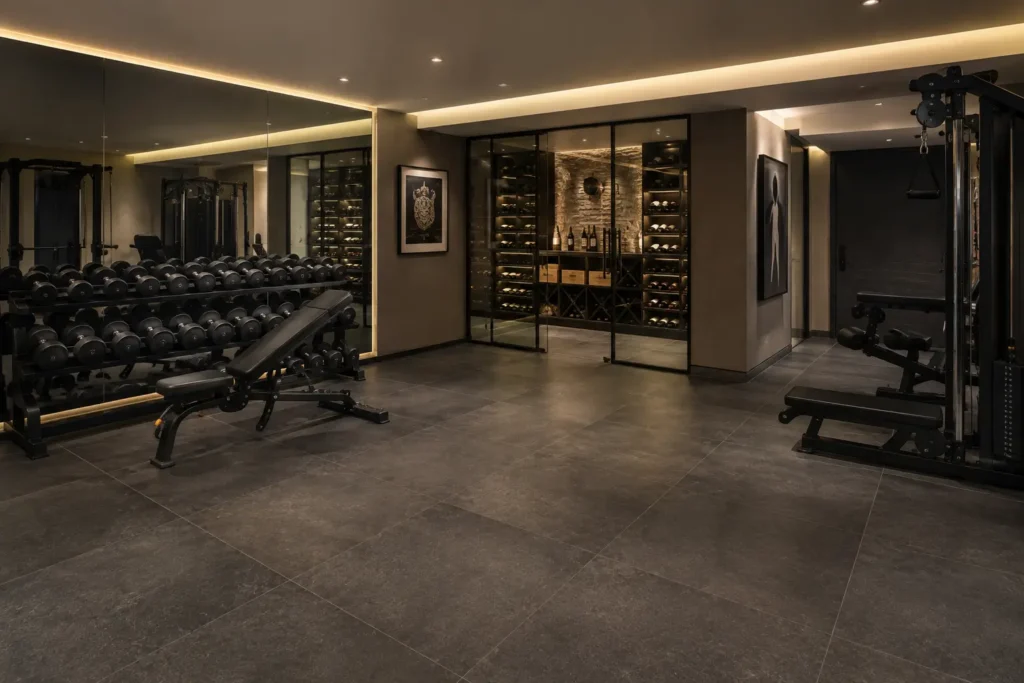
For kitchen worktops used hard, an island in a Notting Hill family house, an outdoor kitchen or any surface behind glass in strong sun, specify porcelain or sintered stone. For a curved profile, a shaped drainer or a scheme where fabrication cost is the constraint and heat exposure is genuinely low, quartz remains a sound choice. For bathroom vanities and wall applications, porcelain wins on the strength of the graphic range alone.
We supply porcelain and sintered stone in full slab format and will say plainly where quartz would serve you better — bring the application rather than the material name.