The basement conversion has reshaped the London house — gyms, cinemas, pools, guest suites and utility space now sit below the pavement in Chelsea, Notting Hill, Holland Park and across Belgravia. The surfaces down there face conditions no ground-floor room does, and specifying them like an ordinary floor is the most common mistake.
Light Is the Governing Constraint
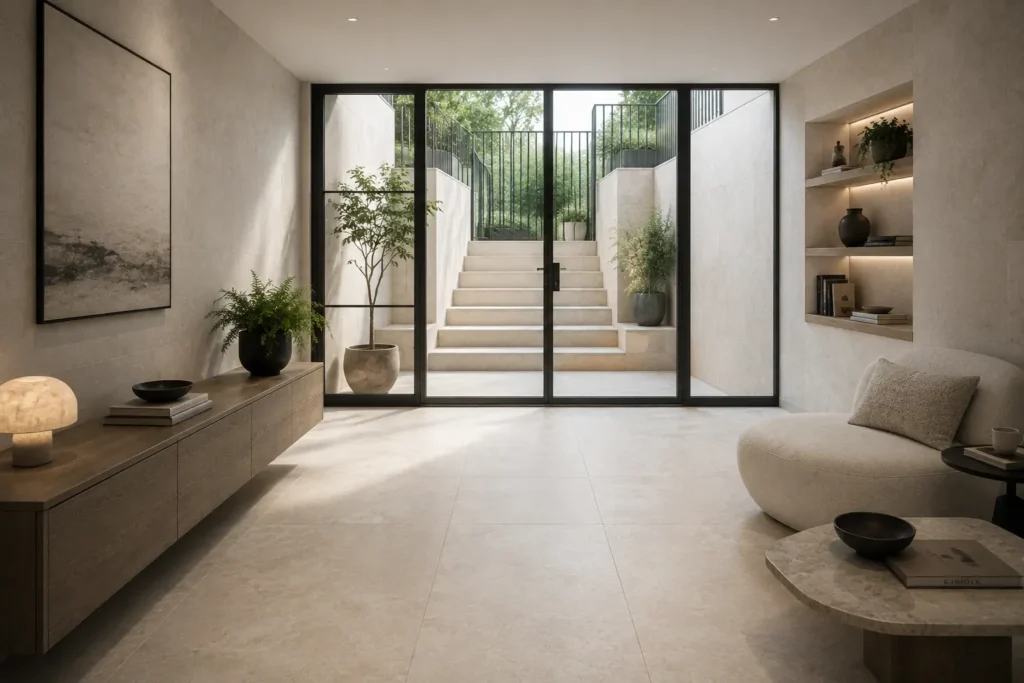
Below street level, almost all light is artificial or borrowed from a light well. Dark floors that look sophisticated in a showroom absorb what little there is and make a basement feel like one. Pale, warm-toned surfaces — bone, ivory, pale travertine, warm greige — return light into the room and lift the ceiling visually. Cool greys are the trap: under artificial light with no daylight to warm them, they read as grey-blue and clinical.
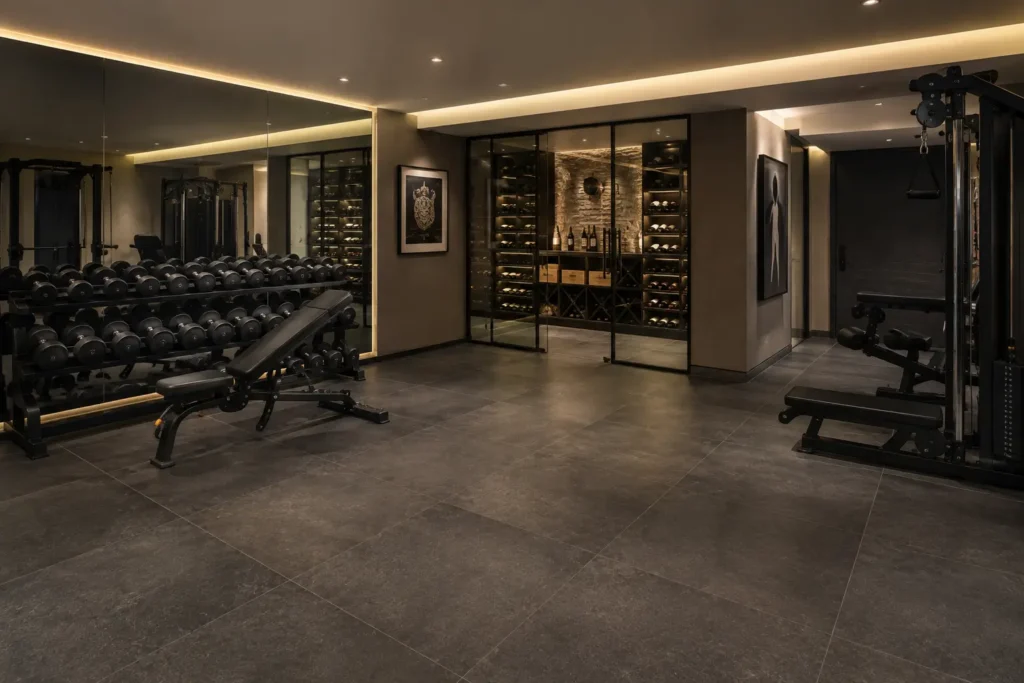
Where a dark surface is genuinely wanted — a cinema room, a wine room — confine it to that room and keep the circulation pale.
Wall surfaces matter as much as floors below ground. Running the floor material up one wall — behind a gym mirror, along a corridor, around a plunge pool — reflects artificial light back into the space and removes the boxed-in quality that basements otherwise acquire.
Moisture and the Tanked Box
A modern basement is a tanked structure with a cavity drainage membrane and a sump. It is dry, but it is a sealed environment, and residual moisture in a new slab can take months to leave. Porcelain is impervious and unaffected either way — one of the strongest arguments against timber and engineered board below ground, where a leak or a slow-drying screed can destroy a floor. Do insist on a calcium carbide moisture test before tiling a new slab.
Movement and Structure
New basement slabs move as they cure and settle. Movement joints must be designed into the tiled floor — at the perimeter, at thresholds and at intervals across large open areas — and carried through from the substrate. Skipping them on a 90-square-metre basement floor is how a premium installation cracks in its second year.
Heating and Comfort
Basements run cool. Underfloor heating is close to essential, and porcelain conducts it better than any alternative. Combined with a warm-toned large-format surface and good lighting, it turns the coldest part of the house into the most comfortable.
Acoustics are the last consideration and the most overlooked. Hard surfaces below ground, with no soft furnishing and no open windows, produce a distinct echo. Rugs, upholstered seating and acoustic plaster on at least one plane make a tiled basement pleasant to be in rather than merely handsome.
We can advise on tone against your lighting design — bring the lighting layout as well as the floor plan.