Nobody chooses a house because of its adhesive. Yet almost every tiling failure we are asked to look at originates in the layers nobody sees — the substrate that was not flat, the primer that was skipped, the adhesive chosen on price. Understanding the invisible half of a specification is what protects the visible half.
Flatness Comes First
For large-format porcelain, the substrate should be flat to within 3mm over a 2-metre straightedge — and for slabs, tighter still. Adhesive is a bonding layer, not a levelling compound; a tiler using it to bridge dips will produce hollow spots and, in time, cracked tiles. Levelling compound is cheap, quick and the difference between a floor that lies flat and one that shows lippage under raking light in a Belgravia hallway.
Priming is equally routine and equally skipped. Absorbent substrates draw water out of the adhesive before it cures; non-absorbent ones need a bonding primer. Either way, the primer is what allows the adhesive to perform as tested.
Reading Adhesive Classifications
European classification is simpler than it looks. C indicates a cementitious adhesive; C2 denotes improved adhesion, and is the minimum for porcelain. S1 means deformable, S2 highly deformable — S1 is appropriate for most floors including underfloor heating, S2 for timber substrates and large slabs. F indicates rapid setting, useful where a floor must take traffic quickly. A specification reading C2S1 tells you most of what you need.
Match the adhesive to the job rather than to habit. A standard C1 adhesive on a 1200mm slab over a heated screed is a false economy that will surface within two winters.
Full Bed Coverage and Back Buttering
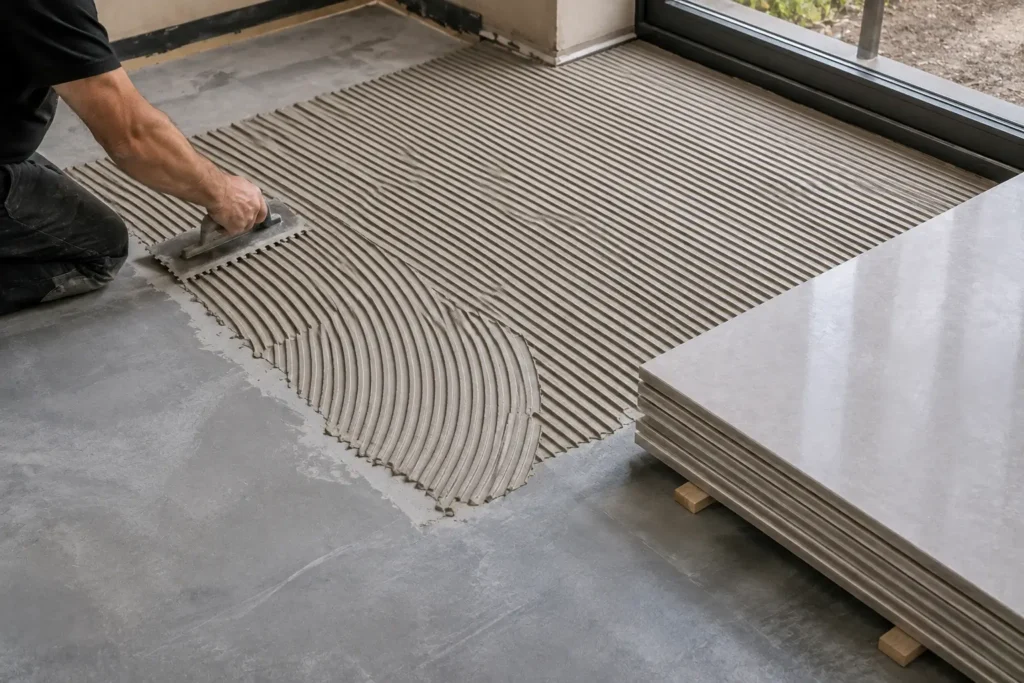
Voids beneath a tile are where cracks begin. British Standards require solid bed fixing — full coverage — for floors, and certainly for anything large format. The technique is to comb adhesive onto the substrate in one direction and also apply a thin skim to the back of the tile, then bed it with a sliding motion to collapse the ribs. Dot-and-dab fixing on a porcelain floor is not a shortcut; it is a defect.
Asking the Right Question
When appointing a tiler, ask which adhesive they intend to use, whether they will prime, and how they will achieve full bed coverage on your format. An experienced fitter will answer immediately and specifically. Hesitation on those three questions is the most reliable early warning available.
It is also worth confirming who is responsible for the substrate. On many projects the builder leaves the floor and the tiler inherits it, and the gap between the two trades is where preparation quietly disappears. Naming the party responsible for flatness and priming in writing costs nothing and prevents the most expensive category of dispute.
We specify adhesive, primer and grout alongside every collection we supply — ask for the full build-up rather than the tile alone.