Mosaic has been out of fashion long enough that it is now specified only where it genuinely performs — which is the healthiest position a material can occupy. Used for the right reasons it solves problems no other format can. Used decoratively, without a reason, it dates a bathroom faster than almost anything else.
Curves, Falls and Compound Slopes
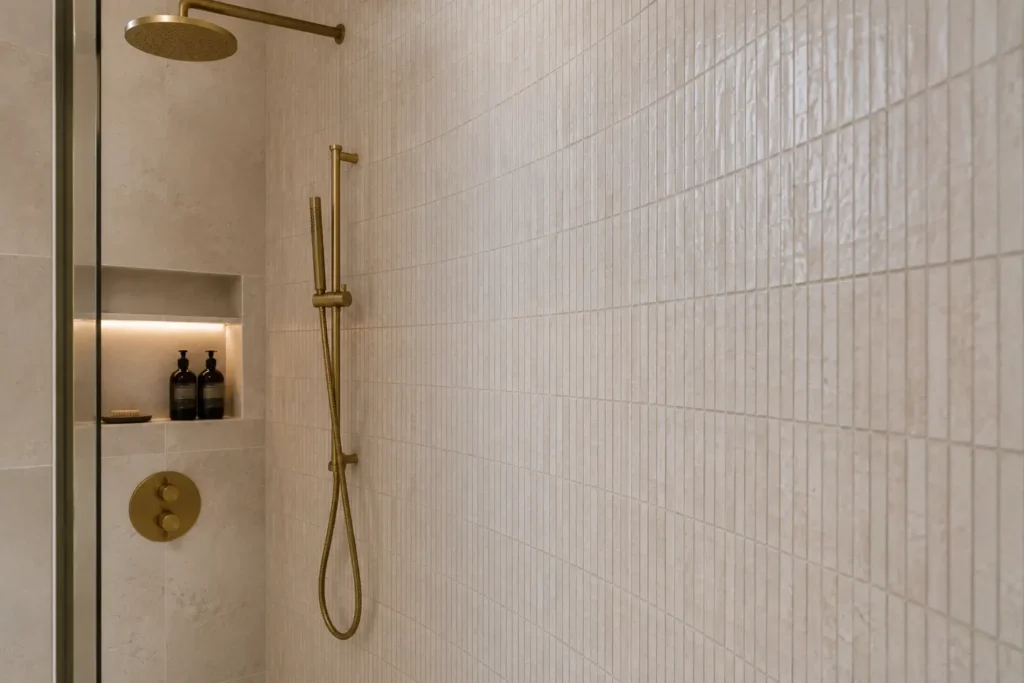
The structural argument for mosaic is geometry. Because each piece is small and the sheet is flexible, mosaic follows curves, coves, compound falls and shaped forms that a rigid tile cannot. A shower floor draining to a central point falls in four directions at once — mosaic accommodates that naturally, where a large tile would have to be cut and wedged. Curved shower walls, barrel-vaulted ceilings in a Belgravia basement, and the transitions in a pool tank all belong to mosaic for the same reason.
Grip Where It Is Needed
A mosaic floor has far more grout line per square metre than any other format, and grout provides grip. In a wet room or a shower tray area, that produces reliable slip performance without needing a heavily structured tile face. It is why mosaic remains standard on shower floors even in schemes where the walls are large-format slab — a deliberate contrast that reads as considered rather than inconsistent.
Where It No Longer Belongs
Mosaic as decoration — a band around a wall, a feature strip at splashback height, a random mix of glass and stone — is the detail that most reliably dates a bathroom to a particular decade. If mosaic is not solving a geometric or slip problem, there is usually a better answer. The exception is a whole surface treated in a single fine mosaic, which reads as texture rather than ornament and can be beautiful in a small cloakroom or a Kensington steam room.
Specification and Installation
Sheet-mounted mosaic requires a flatter substrate than larger tiles, not a more forgiving one — every undulation telegraphs through. Specify a white or matched adhesive under translucent glass mosaic, since the adhesive colour shows. Sheet joints must be aligned so the grid remains continuous, and cut sheets should be adjusted piece by piece rather than trimmed through. This is patient work, and it is worth asking whether your tiler enjoys it.
Quantities are calculated differently as well. Mosaic is sold by the sheet, and a room requiring many cut sheets around curves or penetrations can consume considerably more than the net area suggests. Allow 15 per cent as a working minimum, and more where the geometry is complex.
We supply porcelain, glass and stone mosaics matched to our larger formats — useful when a shower floor must sit within a slab-lined enclosure.