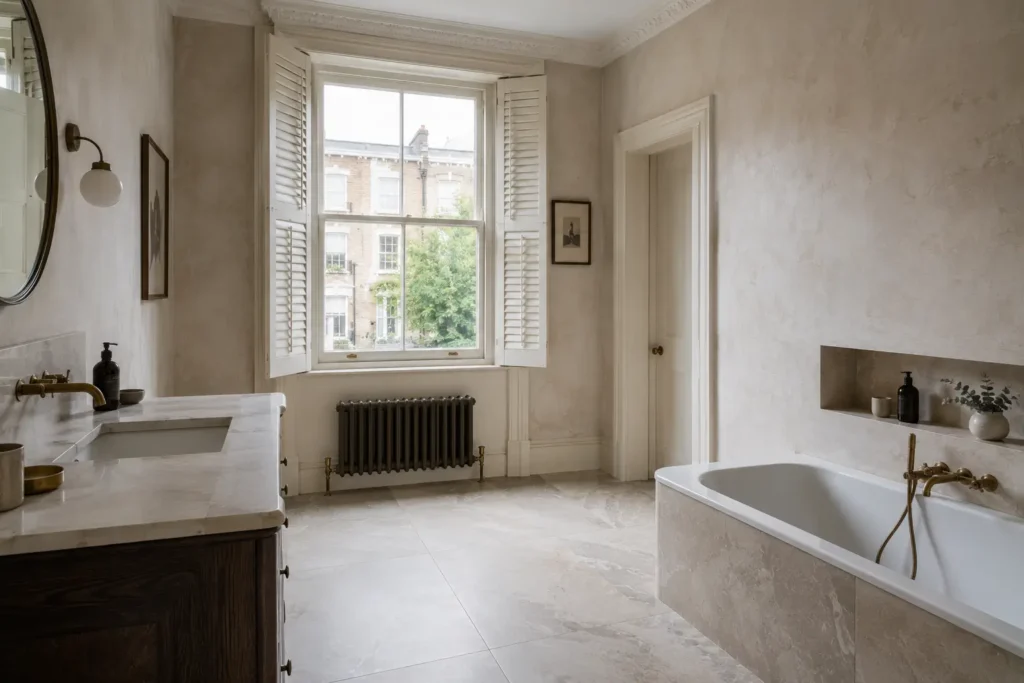
The vanity top is the most closely inspected surface in a bathroom. It is seen at half a metre, touched daily, and subjected to everything a bathroom cabinet contains — perfume, nail varnish remover, toothpaste, hot styling tools. Natural stone struggles with all of them. Porcelain does not, and the fabrication options now available make it the more interesting material as well as the more practical one.
Why Porcelain Outperforms Marble Here
Marble vanity tops etch. Not stain — etch: acetone, alcohol-based products, acidic cleaners and citrus oils remove the polish permanently, leaving dull patches that only professional refinishing corrects. In a principal bathroom in Mayfair or Belgravia used every day for a decade, this is not a hypothetical. Porcelain is chemically inert, needs no sealing, tolerates a hot straightening iron set down without thought, and looks identical in year ten. Where a client wants the appearance of Calacatta or Statuario on a washstand, marble-effect porcelain is the specification that survives contact with real life.
Integrated, Undermount or Vessel
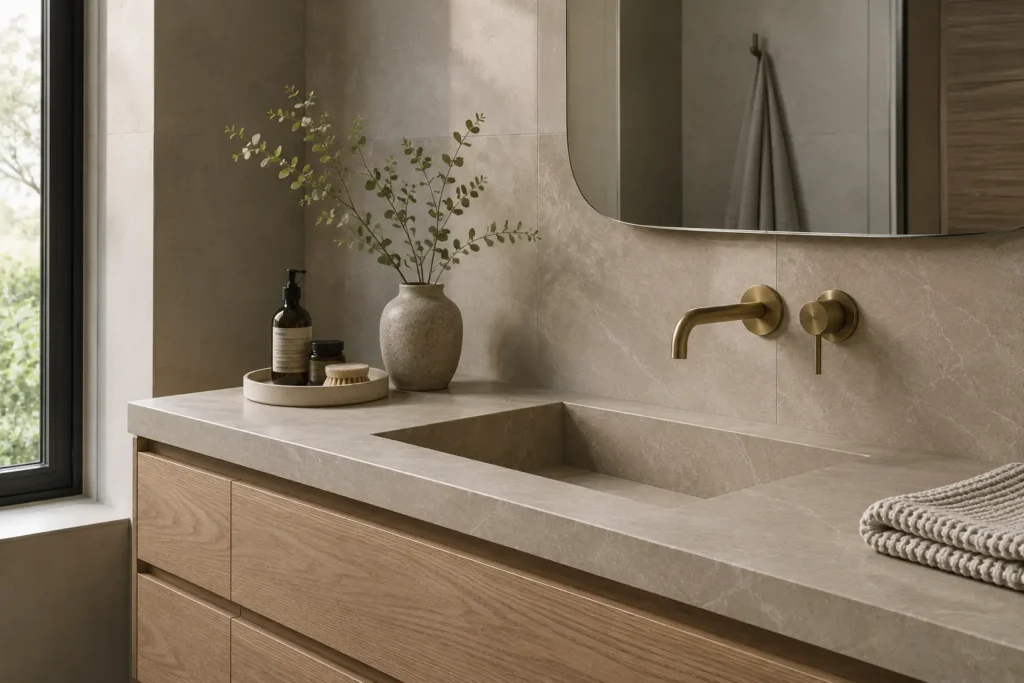
Three approaches. An integrated basin cut from the same slab — fabricated as a shallow tray with mitred internal corners — is the most refined and the most expensive, producing a washstand that reads as one carved piece. An undermount basin, bonded beneath a machined cut-out with a polished reveal, is the pragmatic premium choice: seamless to wipe, considerably less costly, and available in any basin shape. A vessel basin sitting on a flat slab top is the simplest and gives the greatest freedom in basin selection, at the cost of a visible junction and a wipeable ledge.
Edges, Thickness and Waterfall Returns
Porcelain slabs for vanity tops are typically 12mm, built up by mitring to read as 20, 40 or 60mm. A slim 20mm profile suits contemporary bathrooms and floating vanities; a 40mm edge gives weight and suits a larger washstand. A waterfall return — the slab folding down the side of the unit to the floor — is a strong detail in a Notting Hill or Hampstead bathroom where the vanity is freestanding and seen from three sides.
Practical Fabrication Points
Tap holes, waste positions and any upstand must be finalised before templating, since they are machined off site. Templating requires the carcass to be installed and level. Allow a 15 to 20mm overhang to the front and sides, which protects the joinery and reads as intentional. And ask to see the underside detail of a mitred edge before ordering — the quality of that joint is the whole difference.
Consider how the top meets the wall. A separate upstand cut from the same slab, mitred at the junction, reads more cleanly than a silicone joint alone and protects the wall finish behind the basin. Where the wall is already tiled in the same collection, running the material continuously and sealing the junction with colour-matched silicone is the tidier solution.
Bring your basin selection and vanity dimensions to the showroom and we will price the three approaches side by side.