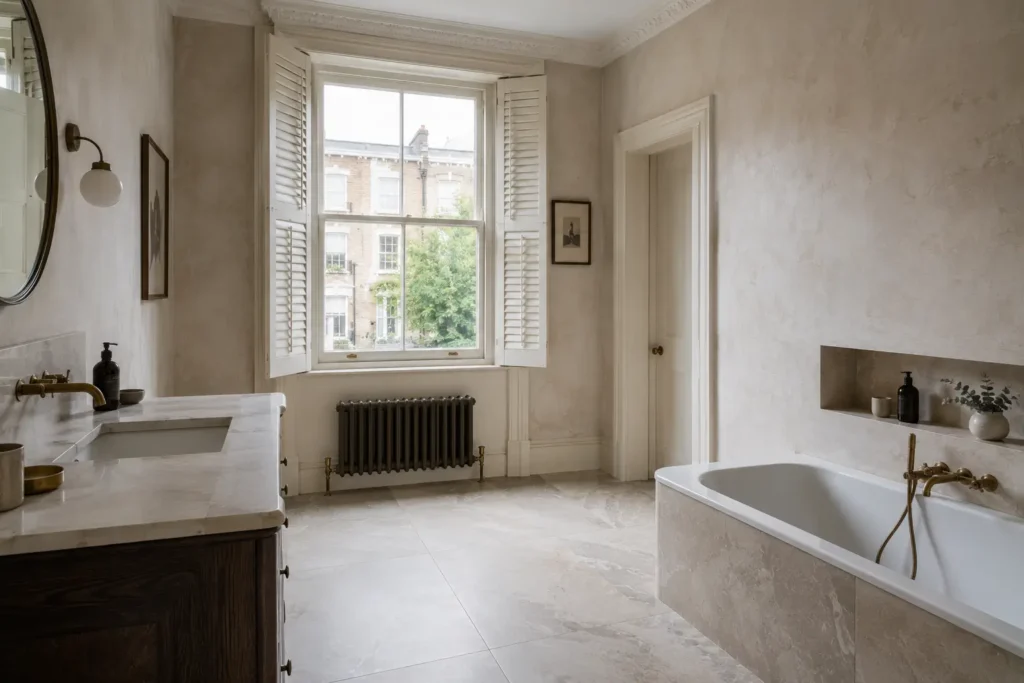
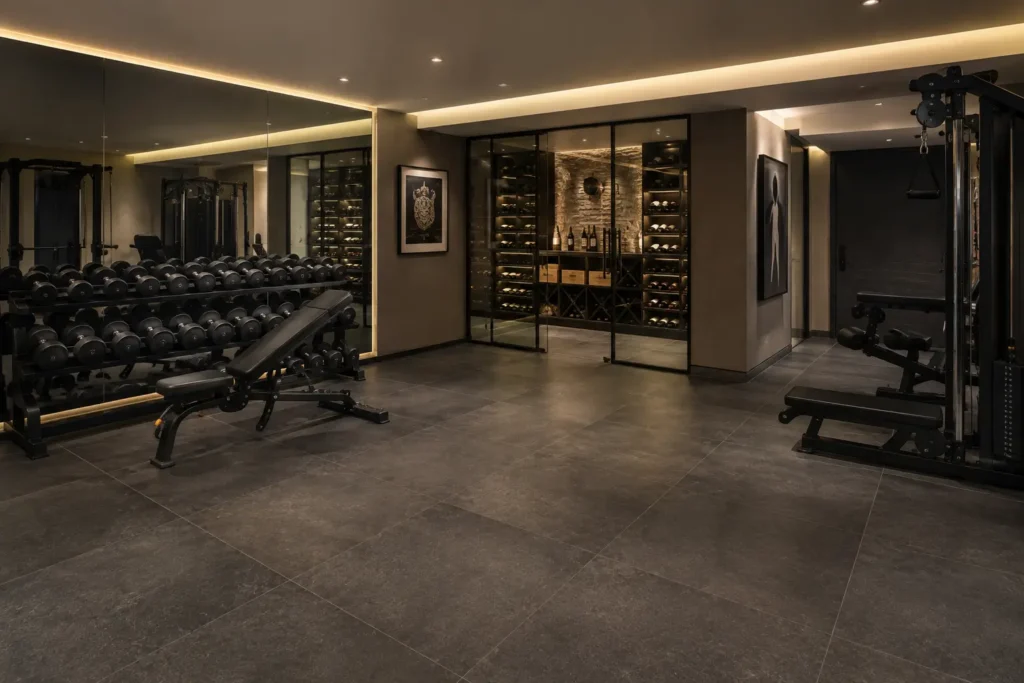
The basement pool and wellness suite has become a fixture of high-end London residential work, from Holland Park to St John’s Wood. It is also the most technically unforgiving environment a tiled surface can face: permanent immersion, chemical exposure, thermal cycling and bare feet on wet stone. Surfaces that perform well anywhere else fail here.
Inside the Tank: Mosaic and Fully Vitrified Bodies
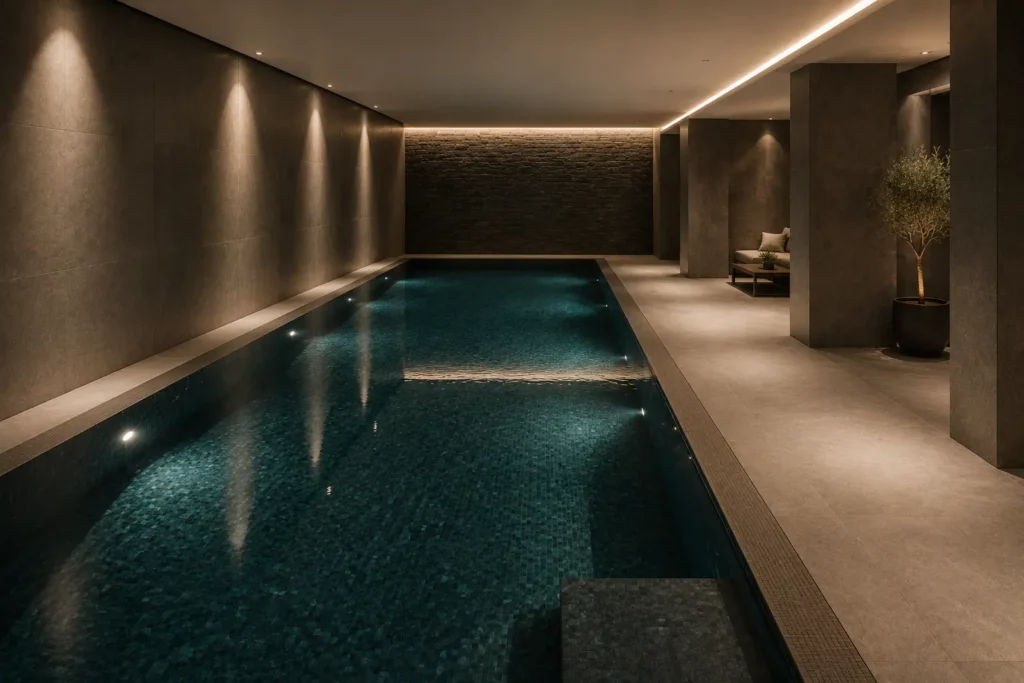
Pool tiles for the tank itself must be fully vitrified, with water absorption below 0.5%, and must tolerate chlorine, bromine or salt systems without glaze degradation. Fine porcelain mosaic remains the standard because it follows curved profiles, steps, coves and channels that no large-format tile can — and because a single damaged piece is replaceable. Sheet-mounted mosaic in 25 to 50mm pieces gives the classic depth of colour, and the colour of the tile, not the water, is what the pool will read as.
Large-format porcelain is now used inside tanks in some contemporary specifications, but only where the shell geometry is genuinely rectilinear and the substrate movement has been fully resolved. It is a decision to take with the pool engineer, not the tiler.
The Surround: Where Slip Rating Governs
For pool surrounds and deck areas, specify a minimum R12 shod rating, or Class C for barefoot wet classification on any surface sloping toward water; Class B is the minimum for a flat wet deck. The current generation of structured porcelain achieves these figures with a face that feels closer to honed stone than to abrasive paving — a considerable advance on the coarse anti-slip tiles of a decade ago, and worth seeing in person before assuming a trade-off.
Coping and edge details deserve early attention. A shaped porcelain coping with a rounded profile is safer underfoot and more comfortable to hold than a square-cut edge, and matched coping pieces should be ordered with the main material, not sourced later.
Colour behaves unexpectedly under water. A mosaic that reads as pale sand dry will appear considerably deeper once submerged, and a mid-blue will darken toward navy at depth. Always view pool tiles wet, and where possible against a sample of the intended water depth, before signing off a scheme for a Holland Park or Hampstead basement pool.
Steam Rooms, Saunas and Wet Zones
Steam rooms cycle between ambient and 45°C at total humidity, which stresses both adhesive and grout. Specify epoxy grout throughout — cement-based grout will not survive the cycling — and a rapid-set, deformable adhesive rated for the application. Curved seats and ceilings again favour mosaic. Ceilings must be laid to a fall of at least three degrees so condensation runs to a wall rather than dripping.
Grout, Movement and Maintenance
Epoxy grout is not an upgrade in a pool environment; it is the specification. It resists chemical attack, does not harbour biofilm, and holds colour. Movement joints must be designed at the tank perimeter, at internal corners and at intervals across large deck areas. And plan access: a well-detailed pool allows a damaged mosaic sheet to be replaced without dismantling anything around it.
We can supply matched mosaic, coping and surround materials from a single collection — bring your pool drawings and we will specify the full package.