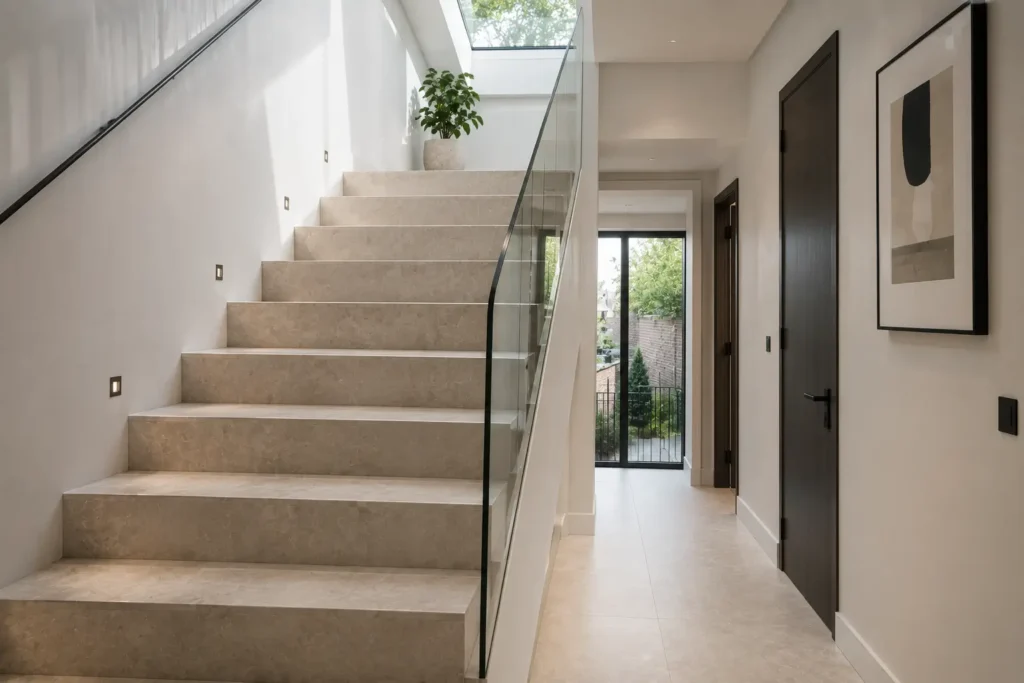
A staircase in the same material as the floor is one of the quietest luxuries available in a house — the eye follows a single surface from hall to landing with nothing interrupting it. It is also the most technically demanding tiling any project will involve, and the one where a good fabricator matters more than a good tiler.
How a Porcelain Tread Is Made
Two routes exist. The first is a purpose-made stair piece supplied by the mill, with a rounded or bullnosed front edge, matched to the floor collection. The second — and the one used in most contemporary London specifications — is a mitred tread, fabricated from the floor tile itself: the tread and the nosing are cut at 45 degrees and bonded so the front edge appears solid, with the printed face wrapping continuously around it. Executed well, no seam is visible.
The mitre is machined off site to the exact going of each step, which means the staircase must be surveyed accurately before fabrication — every step measured individually, because in a period Kensington or Holland Park house they are rarely identical.
Thickness is a design decision within the mitre. A tread built to read as 20mm looks contemporary and light; one built to 40mm reads as solid stone and suits a grander Belgravia staircase. Both are fabricated from the same tile — only the return depth changes.
The Nosing Is a Safety Detail, Not Only a Visual One
Building regulations expect a stair nosing to be visually distinguishable and adequately slip-resistant. A dark stone-effect tread reading against a pale riser satisfies the first; for the second, specify a minimum R10 on the tread face, and consider a discreet anti-slip insert set into the nosing on stairs used by children or older family members. A polished tread on a staircase is a specification to refuse.
Tolerances and Fixing
Stair substrates are rarely square. Each tread must be bedded fully — voids beneath a porcelain tread will crack it under load — using a full-contact adhesive rather than dabs. Risers are set first, treads second, with the tread overhanging by a consistent dimension throughout. Consistency here is what the eye reads as quality.
When to Choose It
Porcelain stairs make most sense where the material continues from the floor below and above, and in houses with underfloor heating throughout, where timber would be an ongoing conversation.
We work with fabricators experienced in mitred porcelain stairs and can arrange a survey before specification.